
Article: The Wheel That Built a Legend | Write-Up
The Wheel That Built a Legend | Write-Up
A California couple. A problem. A flame cutter.
Before the off-road wheel was a category, it was a necessity. When Harry and Sheryl Jackman looked at the wheels available in the 1960s, they saw something missing — a wheel built not for the showroom, but for the trail. For the desert. For the kind of driving that punished everything bolted to your rig.
Harry's answer was elemental. He flame-cut and welded 360-degree steel spokes to 3/8-inch thick outer rims — by hand, in California — to create what would become the original off-road wheel. Not engineered by committee. Not spec'd by accountants. Built by someone who understood that out in the desert, your wheels weren't an accessory. They were a lifeline.
Word spread the way it always does when something actually works. Trails were proven. Races were run. Off-road enthusiasts and racers started asking the same question: where did you get those wheels?
Every wheel in the Jackman line carried one unmistakable signature: that iconic Jackman "J." It wasn't just a logo. It was a shorthand. If you knew, you knew.

Cultural moment
The Bugs found the Jackmans.
Off-road proved the wheel. But the VW scene made it iconic.
Through the 1970s, the Volkswagen community — Bugs, Buses, Bajas — latched onto the Jackman wheel with a fervor that Harry and Sheryl could never have planned for. The design's clean spoke geometry and raw, purposeful aesthetic matched the spirit of the VW culture perfectly: form follows function, character over chrome, the road less traveled over the boulevard cruise.
It became the wheel you ran if you were serious. On the salt flats, in the canyons, at the meets. The Jackman "J" became part of the visual language of an entire automotive subculture.

The quiet end
When the oil ran low, so did the road ahead.
The 1970s oil embargo sent shockwaves through the American automotive world. Driving habits changed. Fuel costs climbed. The carefree spirit that had powered the off-road and VW boom began to tighten. Markets that had been thriving contracted almost overnight.
For Jackman Wheels, the 1980s brought pressures that no amount of good design could fully absorb. The brand that had helped define a category slowly went quiet. Not with a bang — but with the kind of gradual fade that happens when the market shifts under your feet and the timing just isn't on your side.
Harry and Sheryl had built something real. Something that endured in the memories of everyone who had ever run a set of Jackmans. But the brand went to rest, and for decades it stayed there.

The art of an era
Dave Deal drew the world Jackman lived in.
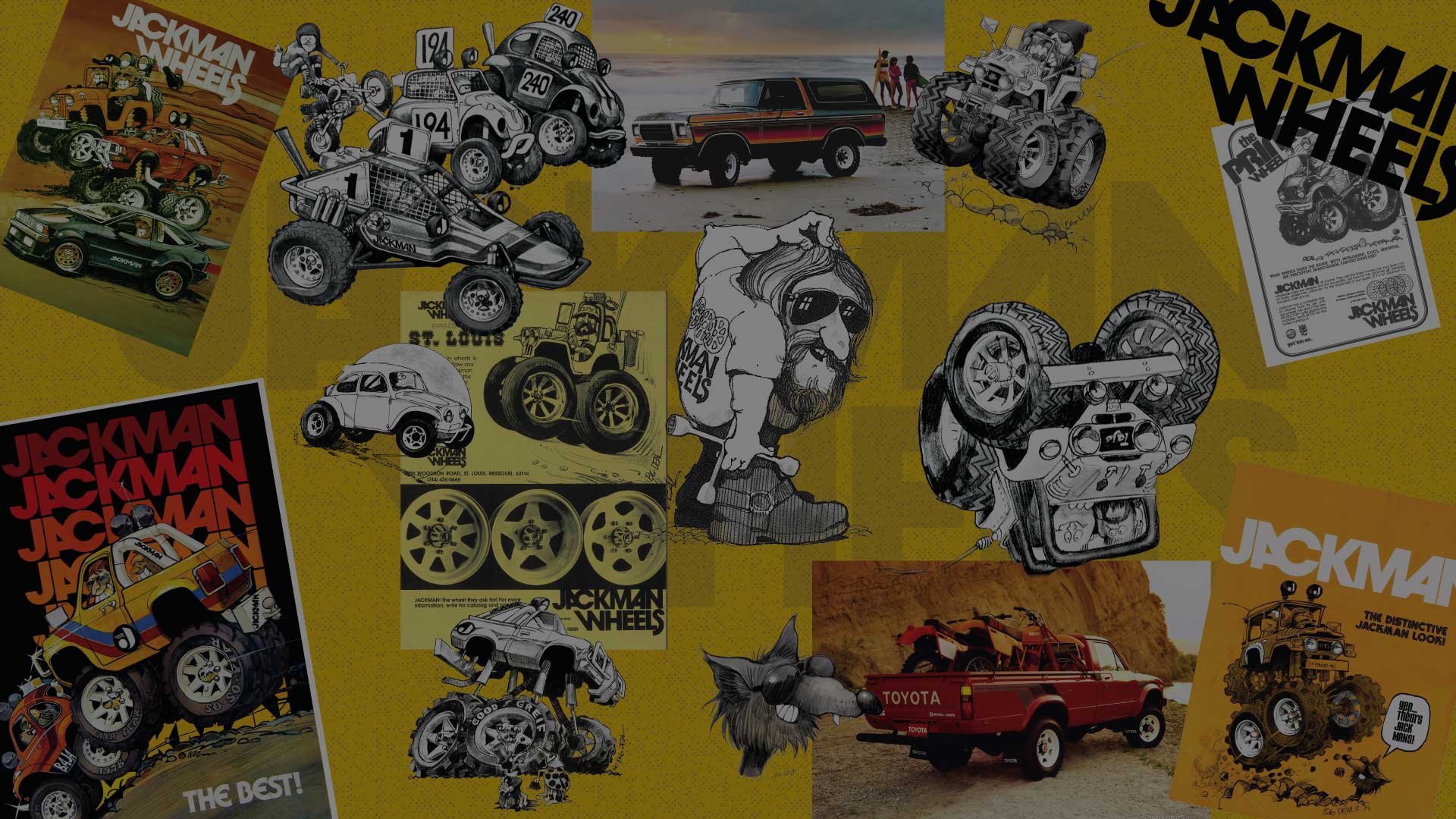
No account of the Jackman era is complete without talking about the art that surrounded it. In the 1970s, American car culture had a visual voice — and much of it came from the pen of Dave Deal.
Deal was an illustrator whose hand-drawn automotive artwork captured the kinetic, larger-than-life energy of the American car scene with a style that was equal parts technical and wild. His work appeared in ads, magazines, and print runs that became collector pieces. He drew cars the way car people saw them — as living things, full of personality and speed.
The world Deal illustrated is the world Jackman Wheels was built in. Original Dave Deal artwork now anchors the Jackman brand revival — a direct line back to that era, preserved on paper, brought forward into 2026.

2026
Some things are worth keeping alive.
Good brands don't really die — they wait. They live in garages, in old magazines, in the memories of people who ran the wheel and never forgot it. Jackman waited long enough.
Harry and Sheryl built something that outlasted the era it came from. The fact that people still talk about the Jackman wheel — still seek out old sets, still recognize the "J" — says everything about what they got right the first time. We're not here to reinvent that. We're here to carry it forward, with the same respect for craft and character that Harry brought to every flame-cut spoke.
The Jackmans are part of this story. They always will be. And now a new generation of builders, overlanders, and adventurists — people running full-size trucks and chasing the horizon just as hard as the desert racers of the 1960s once did — get to write the next chapter.